Last updated: 28th January 2026
ROUND-TRIP CRUISE STATUS
A fact sheet from Emergico Migration. If you are a temporary visa holder in Australia, and contemplating a Cruise which visits another country, it is essential that you understand whether this will have an impact on your Australian visa or any plans for a visa.
If you are a temporary visa holder in Australia, and contemplating a Cruise which visits another country, it is essential that you understand whether this will have an impact on your Australian visa or any plans for a visa.
What is a Round-Trip Cruise?
Generally, when a person is in Australia and then leaves Australia, they are taken to have “left” the migration zone. However, there are certain circumstances where a person may “leave” Australia but be deemed by migration law not to have left – even though they are entering another country on the cruise.
One such circumstance is a Passenger Cruise ship voyage which departs from, and terminates in, an Australian port. If the cruise meets certain criteria, it may be assigned a particular status called “Round Trip Cruise” status. This effectively means that passengers and crew on the cruise are not normally required to be immigration cleared when they return to Australia (although ABF may require ANYONE to be immigration cleared on request).
To obtain Round Trip Cruise status, the cruise ship company must seek a special determination from the Department of Home Affairs which is specific to that particular voyage.
The parameters for meeting the requirements of RTFC status are as follows:
- The Cruise Ship Operator has applied to Australian Border Force for each voyage it wants to be classified as a RTC
- The voyage commences from, and terminates in, Australia, and is not a regular voyage that transports passengers from one place to another
- The voyage does not offer one way or sector fare tickets, with a maximum of 40 way port leavers and joiners, including crew changes
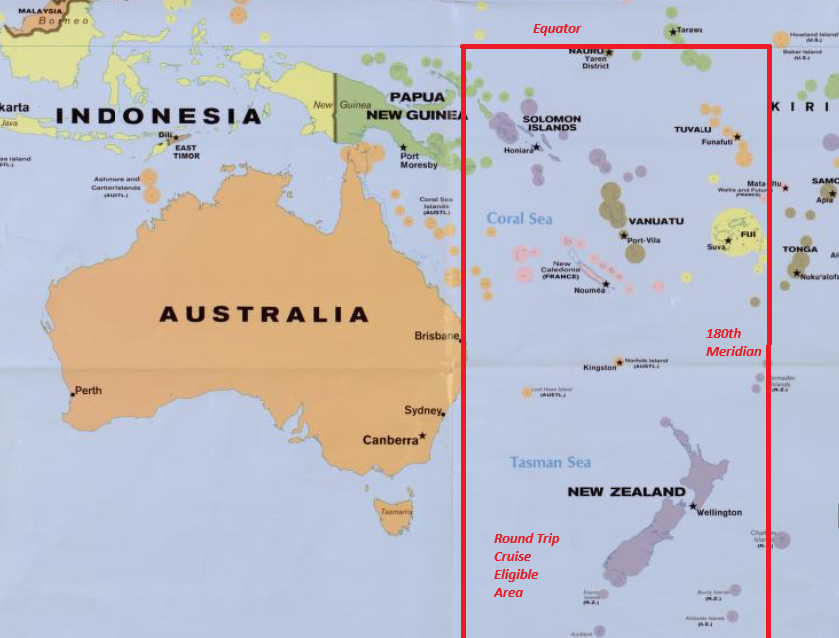
- The voyage only visits ports in countries no part of which lie further north than the equator; no further east that the 180th meridian (Fiji); and not to the west of Australia. (therefore cruises incorporating Indonesia and Papua New Guinea are not eligible)
- Each foreign port is visited only once, and stay period is no more than 24 hours
- The voyage does not raise unacceptable security concerns.
- The total trip does not exceed 30 days
Why is this relevant to visa holders in Australia?
Specifically, this situation may affect temporary visa holders whose visas are expiring and they wish to re-set them, and people who need to lodge an offshore visa application.
Example 1. You wish to leave Australia to re-set a stay period on a temporary visa.
Many visitor visas are multiple entry, meaning entry to Australia is permitted during the visa validity period, and a certain “stay period” is triggered. For example, an eVisitor (subclass 651) visa may have a validity period of 12 months from grant; but each time the holder enters Australia it triggers a 3 month stay period; and they must leave before the stay period expires.
People with a multiple entry visitor visa may take a cruise which goes to another country, thinking it will re-set the stay period, as they believe they will leave Australia and then return on a new three-month visa.
| FACT: A Cruise which has RTC Status DOES NOT re-set any visa that you currently hold. The visa that you hold will continue to run (or expire) as normal while you are on the cruise. Returning to a port in Australia will not mean that you re-set your visitor visa for another entry period, as you are not technically re-entering Australia. |
Real Case Example
Sally is an Australian who is in a relationship with Peter, a UK citizen. Peter is on an eVisitor visa, and they want to lodge a Partner visa while onshore, but Peter’s 3 month stay period is coming to an end in three weeks. Sally has a disability and relies on Peter for support, and they don’t wish to be separated by Peter leaving Australia. She struggles with long flights, so instead they book a return cruise from Sydney which visits Vanuatu. On return, Peter assumes that his visa has now re-set for another 3 months, so they visit Emergico to arrange the partner visa application. However, a VEVO check discovers that Peter is (unknowingly) unlawful. His eVisitor visa has expired and did not re-set on entry to Australia as he thought it would. Peter now has to lodge the partner visa application and meet additional criteria as he has been unlawful.
Example 2. When you must be outside Australia to lodge a visa application.
Some visa applications must be lodged while the applicant is physically outside Australia. Examples include, but are not limited to, offshore partner visa (subclass 309), prospective marriage visa (subclass 300), and temporary sponsored parent visa (subclass 870).
Certain people in Australia may be subject to a bar on a further onshore application while in Australia – for example – people on a bridging visa who have been refused a visa since their last entry to Australia. Their next visa application must be lodged while they are offshore.
| FACT: Taking a round-trip cruise DOES NOT allow you to lodge an application which must be lodged from offshore, as you are deemed not to have left the migration zone. If you lodge such an application, it may be deemed invalid. |
Real Case Example
Desmond is applying for a Temporary Sponsored Parent (870) visa. He’s currently in Australia on a Visitor visa, and his parent sponsorship has been approved but he knows he has to leave Australia to apply for the 870 visa. He’s always wanted to visit New Zealand and decides to book a return cruise from Australia which stops in Auckland. Once he’s offshore, his daughter in Australia attempts to lodge his 870 visa through the IMMI account, but she is unable to do so as it shows that he is still “in Australia”. Consequently, he has to return from the round-trip cruise and then take another trip by plane to ensure he is not in Australia.
Bridging Visas and Round-Trip Cruises
When leaving Australia at any time, to return to Australia you must still hold a visa which allows re-entry. This situation still applies while on around trip cruise.
Therefore, it’s important to ensure your Australian visa does not expire while you are offshore, or that you have another visa in place (such as a bridging visa B with a valid re-entry period) which allows you to re-enter Australia.
If for example you are in Australia and holding a Visitor Visa which specifies SINGLE ENTRY, you would most likely be unable to take a cruise from Australia (if it enters an international port) and then re-enter Australia at the end of the cruise, unless you have applied for and been granted another visa.
If you’re holding a Bridging Visa A or a Bridging Visa B with an expired travel period, you need to obtain a Bridging Visa B before travelling.
If you are holding a Bridging Visa C or E, you do not have re-entry rights to Australia so it would be unwise to take a cruise which visits an overseas port.
How do I know if my cruise has Round-Trip Cruise status?
If any of the situations above are of concern to you and you are contemplating a cruise which fits the parameters above, we recommend you check with your travel agent or the cruise ship company itself and ask for confirmation in writing about whether the cruise has been designated Round-Trip Cruise status.
If you would like to discuss your situation, please feel free to book a consultation with one of our Registered Migration Agents.
Map of RTC Permitted Area